Tell us about the job
Takes about a minute. No obligation.
A boiler flagged for repair in this county has already been working through conditions that stack up over time. 293 severe weather events were recorded in Williamson County, Tennessee between 2015 and 2024. At that rate, severe weather is a standing feature of the operating environment, and a contractor diagnosing a failed component has to account for what the system has absorbed before settling on a cause. Heat exchangers, pressure relief valves, and flue seals all carry that load differently, and a repair quote that ignores cumulative wear will miss what actually failed.
Stock built around the turn of the century was fitted with boilers that are now well into the part of their service life where the manufacturer has discontinued components or handed supply to third-party vendors. Half the homes in Williamson County, Tennessee were built in 2002 or earlier (2020-2024 ACS 5-year). That means a contractor opening a failed unit here faces a different job than the diagnosis alone suggests: identifying the fault is one step, but confirming that a replacement part ships in a reasonable window is what actually decides whether the repair proceeds or the conversation shifts to replacement. Heat exchangers, zone valves, and circulator assemblies in systems of this age sit in that middle ground where some parts are still catalogued and some are not.
The Parts of a Boiler a Contractor Checks First
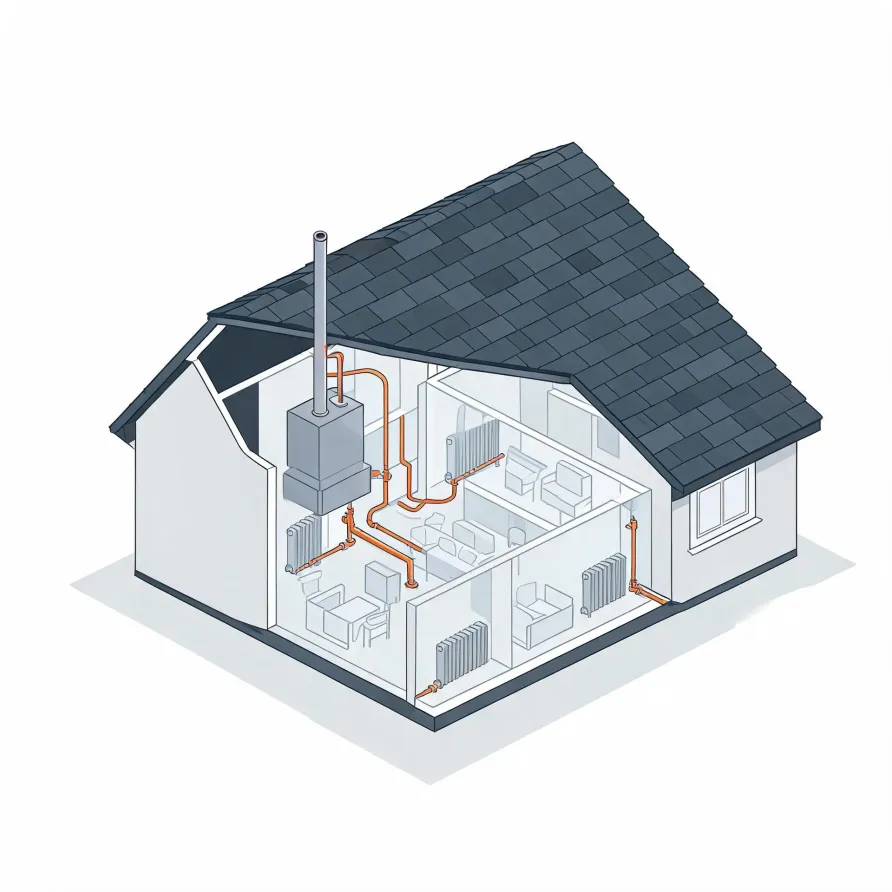
The boiler itself sits in a mechanical room, basement, or utility closet and is the unit a contractor goes to first when something fails. Inside it, the heat exchanger and burner assembly are the pieces most likely to be behind a loss of heat or pressure, and both are examined closely before anything else.
The circulator pump moves heated water out through the supply pipes and back through the return lines, and a failed pump is a common reason rooms stop warming. The expansion tank, pressure relief valve, and zone valves each sit along those lines and each can produce its own distinct set of symptoms when worn or blocked.
The drawing shows a typical boiler layout, and a licensed contractor determines which parts and configurations apply to your specific system.
Find a contractor in Williamson CountyWilliamson County, by the numbers
293 severe weather events were recorded in Williamson County, Tennessee between 2015 and 2024.
NOAA National Centers for Environmental Information, Storm Events Database, bulk CSV export, events 2015-01-01 through 2024-12-31.Half the homes in Williamson County, Tennessee were built in 2002 or earlier (2020-2024 ACS 5-year).
U.S. Census Bureau, 2020-2024 American Community Survey 5-Year EstimatesWilliamson County, Tennessee holds 96,921 housing units (2020-2024 ACS 5-year).
U.S. Census Bureau, 2020-2024 American Community Survey 5-Year EstimatesOwners occupy 78.8% of the occupied homes in Williamson County, Tennessee (2020-2024 ACS 5-year).
U.S. Census Bureau, 2020-2024 American Community Survey 5-Year EstimatesBoiler Repair Rules and Codes for Williamson County, Tennessee1 sourced standards and regulations
Licensing and Legal Requirements in Williamson County, Tennessee
Tennessee licenses contractors by classification, and HVAC, refrigeration and gas piping is one of them — a sub-classification of mechanical contracting on the licence the Board for Licensing Contractors issues.
Severe Weather Events in Williamson County
Hard weather puts real strain on heating equipment: pressure swings, power surges, and extended run times all push boilers toward failure. How often that happens here shapes how much repair work local boilers actually need.
293 severe weather events, 2015–2024. Source: NOAA National Centers for Environmental Information, Storm Events Database.